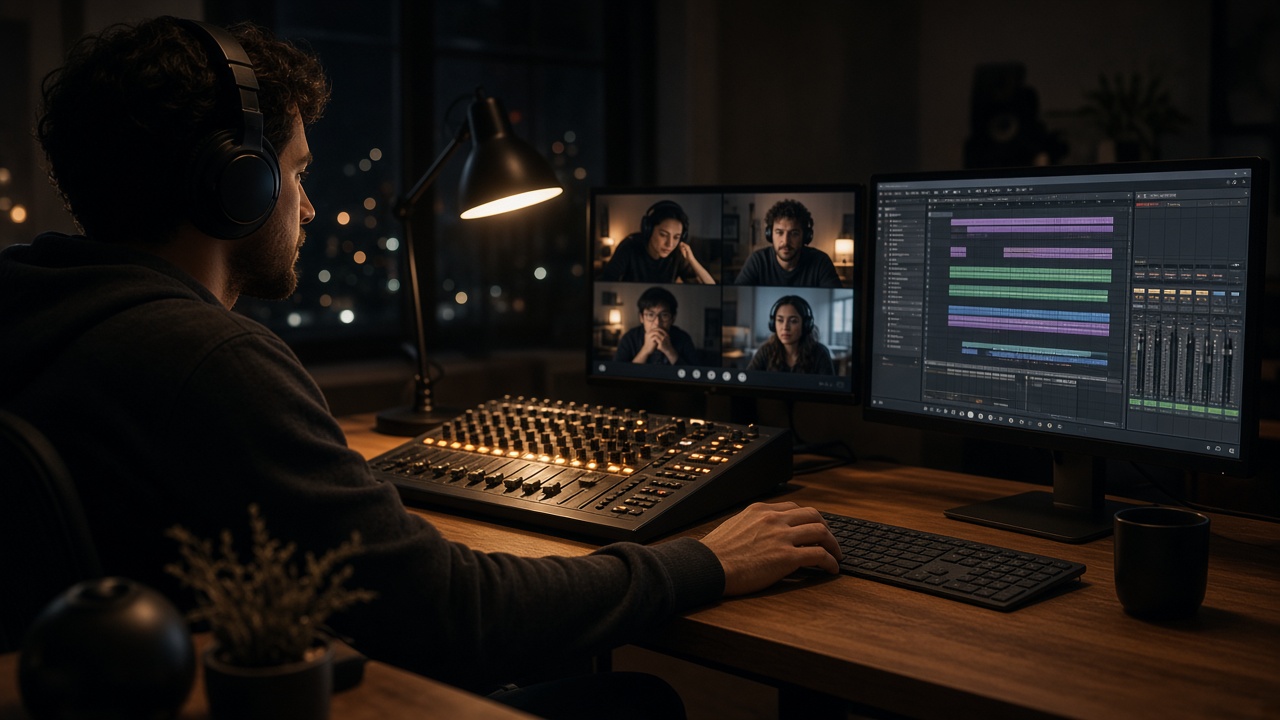
Remote music production workflow that keeps MIDI, plugins, and versions in sync
Distributed teams succeed when the session—not the inbox—owns the truth about structure, instruments, and edits.
Remote music production became normal faster than our habits updated. We learned video calls, shared playlists, and endless cloud folders—but many teams still treat the “real project” as whatever file last landed in someone’s Downloads folder. That works until MIDI needs a last-minute transpose, a synth patch must change across twelve bars, or two people edit different sections without knowing the other just moved the downbeat marker.
A durable remote workflow centers on one authoritative session state: editable MIDI where possible, plugin-aware tracks, and version history that humans can read. Bounces remain milestones for mastering and clients, not the connective tissue between every creative decision. The sections below outline how to get there without pretending networks are perfect or that every collaborator needs the same software brand.
The failure mode: stems as conversation
Stem ping-pong is seductive because it is universal: everyone can play WAV files. The hidden cost is loss of structure. Drum edits become destructive audio surgery. Chord substitutions require regeneration from scratch. Feedback arrives as timestamps on a stereo file while the producer guesses which revision was heard. Multiply that across time zones and you get decision lag measured in days.
Stems still matter—for mastering, for singers tuning in external tools, for archival—but they should sit at the end of a branch, not on the critical path of writing. When stems become the default dialect, you have stopped producing remotely and started emailing mixes to yourselves.
MIDI as the lingua franca of remote writing
MIDI travels light and stays editable. A co-writer can reshape voicings, quantization, and length without re-recording audio. For electronic genres, MIDI often is the performance, with expression carried by synth macros and automation. Shared sessions should keep MIDI events on named tracks with clear ownership so merges are intelligible.
Establish conventions: which tracks are “proposal” lanes versus committed arrangement, whether note color or prefix tags mark experimental layers, and how you consolidate after a good take. MIDI without conventions becomes a junk drawer as stressful as unlabeled stem folders.
Versions should tell a story: who changed bar 33, why the bridge moved, and which plugin state the chorus relied on—not only which zip file is newest.
Plugin parity and honest substitutions
Plugins are where remote workflows fracture. One machine missing a license, a different sample content path, or an AU/VST3 mismatch turns a join session into a forensic exercise. Start projects with a shared manifest: required instruments, acceptable replacements, and who hosts CPU-heavy chains.
When parity is impossible, freeze at the boundary with notes in the project—marker text, track suffixes, or branch labels—so nobody assumes a live synth is still editable. Transparent failure beats silent substitution that sounds “almost right.” On macOS teams, standardizing on VST3 and Audio Units you all actually own saves more time than exotic one-off inserts nobody else can open.
Versioning without version chaos
Git taught engineers about branches and merges; producers often improvise with filenames. Better approach: use host-native snapshots, song duplicates for radical directions, and session changelog habits—short marker names after major decisions, dated notes for client listens. If your tool supports shared history, insist everyone can see AI and human edits in one timeline.
Agree when to branch versus edit in place. Radical structural experiments deserve a duplicate song; nudging a fill pattern does not. Roll back confidently when you know undo boundaries are per-editor or global, and document that before a tense deadline.
Roles, time zones, and async overlap
Not everyone is online simultaneously. A good remote workflow separates synchronous co-editing blocks from async passes with explicit handoff markers: “Topline review through bar 48—do not move markers until 18:00 UTC.” Roles reduce collisions: one arranger edits structure, one designer tweaks timbre, writers work inside designated lanes.
Async does not mean stale. Listen-only presence while someone else drives keeps feedback immediate without risking accidental edits. The worst outcomes come from silent edits during someone’s offline comping session because permissions were vague.
Session health checklist
- Confirm sample rate, buffer targets, and who hosts the heaviest plugin load.
- Publish a plugin manifest and replacement plan before the first shared edit.
- Test dense playback on the host machine before inviting collaborators.
- Define MIDI track ownership and naming for proposals versus committed parts.
- Use markers for handoffs, client listens, and branch points—not only filenames.
- Reserve stem exports for milestones; keep creative iteration in the session.
- Verify rejoin behavior after drops so transport realigns without duplicate projects.
Network and realism
Remote production still runs on home uplinks, Wi‑Fi collisions, and laptops on battery. Prefer wired connections for hosts when possible, declare buffer expectations, and avoid redundant full-project uploads when incremental sync exists. Headphone cue norms and talkback etiquette matter for vocal sessions as much as bandwidth charts.
Tools should surface sync state clearly: who is following transport, who is auditing locally, whether latency compensation is engaged. Producers forgive milliseconds when the UI tells the truth; they forgive nothing when two people argue about a drop that sounded different in each room.
Putting it together with collaborative DAWs
Cuepoint Studio is built as a professional AI-native collaborative DAW for macOS—local engine, VST3/AU, shared sessions with presence and editing, and AI that works inside the project. It is not a browser generator or a mastering shortcut; it is infrastructure for teams who want MIDI, plugins, and versions aligned while distributed.
Study how shared sessions work, connect AI assistance via the in-studio coproducer, and start a pilot via download with the same template you would have shipped in a zip yesterday.
Client and label-facing hygiene
Remote workflows break trust when externals hear the wrong revision. Before a client listen, freeze a snapshot name in the project, mute experimental lanes, and confirm everyone in the session is on group transport—not local loop audition. Send offline bounces only from that named snapshot, and paste the marker note into the email so feedback maps to bars your team still controls in MIDI.
Labels and sync supervisors increasingly ask about session integrity: can you deliver stems with documentation, can you adjust tempo at bar forty without rerendering the entire record? Keeping the authoritative session healthy matters as much as loudness on the streaming meter. Producers who can say “give me an hour in the project” instead of “give me two days for stem surgery” win repeat business in distributed rosters.
Make changelog discipline boring: who hosted, which plugin manifest version applied, which AI suggestions were accepted on which tracks. Boring logs save exciting careers when a supervisor requests a TV mix with alternate vocals forty-eight hours before air.
When in doubt, over-communicate bar numbers in chat tied to transport, not approximate timestamps on bounced files.
Assign a single session captain for client week who owns changelog markers; rotating captains without handoff notes recreate the inbox problem inside the DAW.
Closing the loop at delivery
Delivery day should not be the first time versions reconcile. Schedule a dry run mid-week where collaborators bounce nothing but open the same snapshot, solo the same buses, and read the same marker changelog. Disagreements caught mid-process cost minutes; disagreements caught at mastering cost days and trust.
Remote music production scales when everyone agrees what “synced” means: same bar grid, same plugin manifest, same branch name, same person empowered to merge. Anything else is a folder of talented people working in parallel fiction.
KEEP READING
You might also like
Why VST3 and Audio Units still matter in an AI-native DAW ↗
Your plugin rack is your sound. AI should work with it—not replace it with a closed library.
How to use AI in music production without losing control ↗
Preview, compare, undo. Keep creative judgment with the producer while AI proposes editable options.
Electronic music production on macOS: what a modern DAW must do ↗
Arrangement, MIDI, mixing, plugins, and performance—what electronic producers should demand in 2026.